AI Scope of Work: What 2026 Enterprise Intake Data Tells Us
Collective Intelligence
Knowledge Base
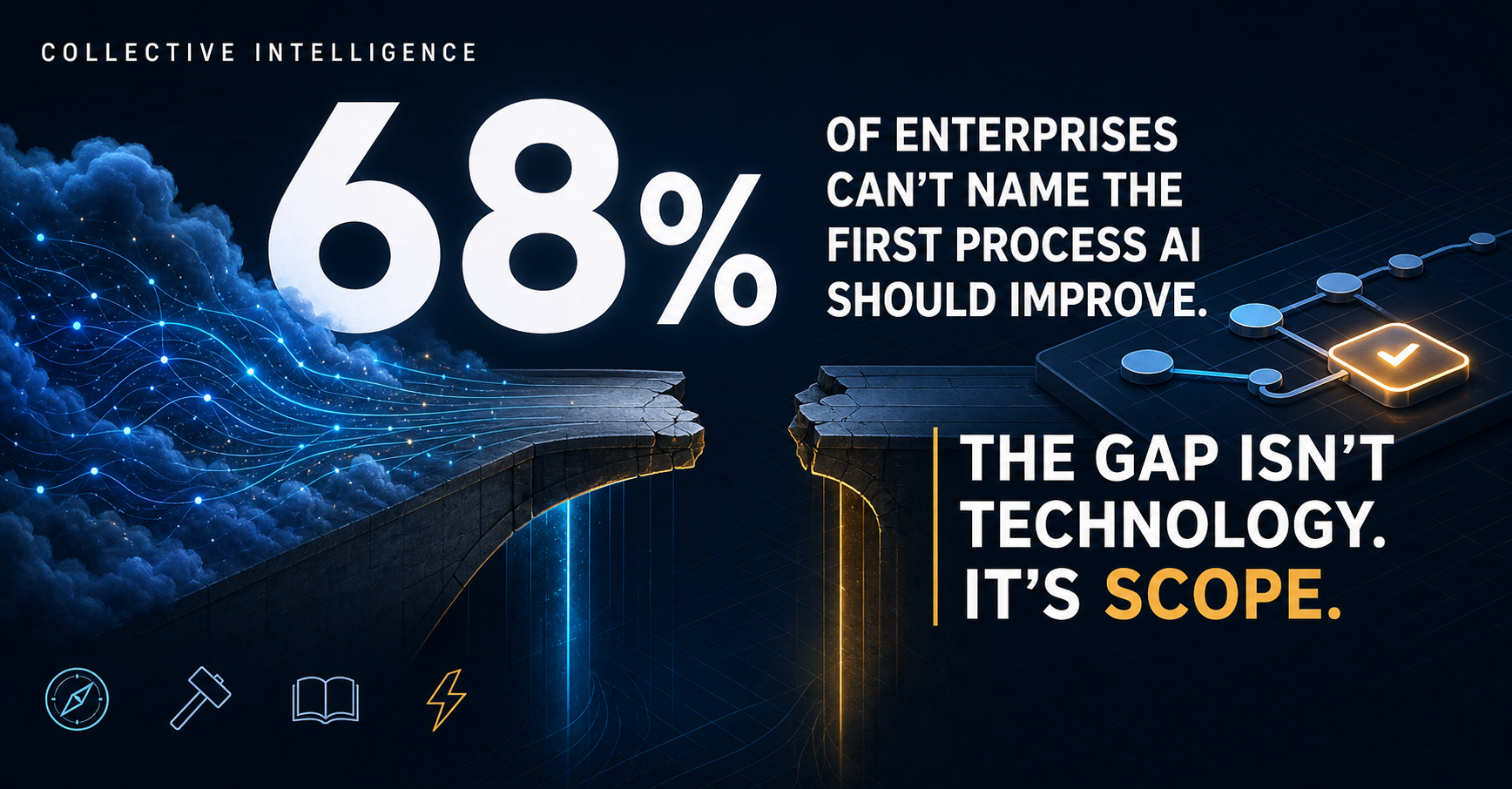
Every week, organisations approach us with the same question: 'We know we need to do something with AI — but where do we actually start?' After reviewing intake assessments from dozens of enterprise engagements across Q4 2025 and Q1 2026, a clear picture is emerging. The barriers to AI adoption are not technical, not budgetary, and almost never about the AI itself. They are about scope — specifically, the inability to define it.
When we begin working with a new client, one of the first tools we use is an AI Scope of Work assessment — a structured intake process that maps organisational readiness across four dimensions: data maturity, process clarity, human capability, and governance appetite. What we consistently find is that organisations arrive believing they have a technology problem. What the data reveals is that they have a scoping problem. In 2026, the pattern is sharper than ever: 68% of intake clients cannot clearly articulate which business process they want AI to improve first. 54% have no designated internal owner for AI initiatives at the operational level. 41% are running parallel AI pilots with no mechanism to compare results or consolidate learnings.
The most common initial request we receive is a technology recommendation — 'should we use ChatGPT Enterprise, Microsoft Copilot, or build something bespoke?' This is almost always the wrong first question. What the intake data shows enterprises genuinely need falls into three buckets: a single clear starting point, a governance framework that enables rather than blocks, and internal capability built alongside technology.

The organisations that move fastest are those willing to scope aggressively. Rather than building an 'AI strategy,' they identify one high-value, bounded process — a customer onboarding workflow, a reporting cycle, a document review process — and go deep on that first. Our intake framework surfaces these starting points systematically. The criteria are simple: high frequency, documented process, measurable output, and a human who currently owns the task and is willing to partner with AI. When all four exist, you have your first use case.
Governance is cited as a barrier in nearly every intake assessment. But when we dig in, we find two very different things: legitimate risk management, and institutional paralysis dressed up as due diligence. The organisations making progress in 2026 have built lightweight governance frameworks — clear ownership, defined risk thresholds, and a default posture of test and learn within guardrails rather than wait and observe indefinitely.

Across our intake cohort, we see three distinct readiness profiles. AI-Ready organisations (approximately 22%) have clear process documentation, a culture of measurement, and cross-functional buy-in — they need an acceleration partner, not a foundation builder. AI-Adjacent organisations (approximately 55%) have pockets of enthusiasm and some process clarity, but inconsistent data practices and unclear ownership — they need structured scoping work before any technology decisions. AI-Distant organisations (approximately 23%) have fundamental prerequisites missing: undocumented processes, fragmented data, or cultural resistance that runs deeper than individual scepticism. They need change management before AI strategy work. Knowing which profile describes your organisation is the most valuable output of a structured intake assessment.
Real-life example
A 450-person professional services firm approached us with a board-level AI mandate and no starting point. Three teams were already running independent AI pilots with no shared evaluation framework. The most frequently requested use case — automated client reporting — had no documented process and no operational owner. After a structured AI Scope of Work assessment, we identified a single bounded starting point: an internal knowledge retrieval workflow with clear ownership, a measurable output, and a willing lead. That was the first deployment. Within one quarter, they had a live AI capability and a template for evaluating the next one. The mandate that had felt overwhelming became a programme with a clear sequence.
CI Insight
The organisations winning with AI in 2026 are not necessarily those with the most advanced technology or the largest budgets. They are the organisations that were honest about their starting point, scoped their first use case tightly, built internal ownership, and iterated in the open. The gap between AI-adjacent and AI-ready is closeable — but it requires structured work, honest assessment, and a partner who will tell you what the data shows rather than what you want to hear.
Related Insights
AI as Your Strategic Devil's Advocate
Every leadership team has a groupthink problem. AI has no social anxiety, no career concerns, and no loyalty to your existing strategy. It will tell you what's wrong with your plan if you ask — which most people never do.
AI for Competitive Intelligence That Actually Informs Strategy
Generic competitive research produces generic insight. The organisations using AI most effectively are using structured frameworks to force specificity, and running the output through strategic filters rather than treating it as finished analysis.
The Persona Test: Seeing Through Your Customer's Eyes
Before any customer communication, campaign, or product decision goes out, the best question isn't "does this look good?" — it's "how does this land for the person on the receiving end?" AI lets you run that test in seconds.
Explore the full knowledge base
Frameworks, mental models, and practices that build real AI fluency — curated from CI's client work.
Back to Insights →